
 Back
Back-
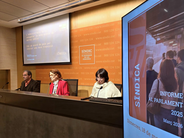 Catalan Ombudswoman Esther Giménez-Salinas presenting the 2025 Annual Report

In 2025, the institution recorded more than 25,000 actions, a record figure
The growth in complaints in regard to social matters stands out
The report's figures show the Catalan Government is under strain, slow, fails to respond to citizens' needs and has lost the capacity to carry out profound transformations
On 18 March 2026, the Catalan Ombudsman office presented the annual report for the year 2025, a document that records all its supervisory activity over the public authorities and the state of citizens' rights.
The report states that the current Government is at the end of an era and that it is therefore essential to rethink the model to adapt it to the new social, demographic and technological challenges of present-day Catalonia: "It is not a matter of taking isolated measures. We are talking about a profound transition – structural, cultural and long-term – so that the Government can recover its raison d'être: to be at the service of citizens", the Ombudswoman stated.
An unequivocal sign that the current Government is not responding to current needs is that the institution has received more complaints than ever. During 2025, more than 25,000 actions were recorded, the highest volume in the institution's history, with 13,646 complaints, 11,428 enquiries and 213 ex officio actions.
This growth is particularly significant regarding social rights which, for the first time, account for more than half of the complaints, 50.1%:
- Social services, a 61.6% increase in complaints
- Housing, 52.4%
- Health, 43%
- Childhood and adolescence, 40.1%
- Education, 19.1%
Also worth highlighting is the increase recorded in transport and mobility (51.6%), especially complaints related to the operation of the Rodalies commuter train (578 complaints, 136% more than in 2024). Regarding complaint resolution, irregularities were detected in 43.3% of the complaints, and the Government has accepted 92.3% of the recommendations and suggestions, either fully or partially.
A system under strain in the face of more complex social needs
The report highlights several paradoxes in how the Government currently functions. To begin with, despite the increase in resources allocated to social policies, the pressure on assistance services and the feeling of being overwhelmed among professionals in basic public services (basic social services, primary healthcare and educational centres, among others) has grown.
In many cases, administrative procedures remain complex and slow, resulting in delays in accessing rights and benefits. Furthermore, in some areas, waiting lists have increased and waiting times have lengthened compared with 2024. For example, in the health sector, there are 4% more patients waiting for surgery (with a waiting time of 148 days) and 8% more patients waiting for diagnostic tests. As for older people and people with disabilities, waiting lists have also increased: by 7% in elderly care homes (583-day wait) and by 6% in residential services for people with disabilities (1,991-day wait). The processing time for the citizens' guaranteed income has increased from 76 to 122 days.
Administrative controls, which have multiplied, have also been criticised. Although they constitute a guarantee of legality, in some cases they have become obstacles to real effectiveness. They can become an unbearable burden for citizens and public servants, who spend 30% of their working day on bureaucratic tasks, and this is to the detriment of the public service.
The report also warns that many social benefits do not reach everyone who needs them. Around 60% of people in a situation of extreme material deprivation receive neither the minimum basic income nor the citizens' guaranteed income.
Another indication that the current Government has reached the end of an era is the slowness with which major transformations are advancing. For example, the single window in the field of social services is still not a reality, despite being scheduled for 2025. In environmental matters, a decisive push is also lacking to deploy renewable energies. And in housing, a stable social housing stock has not been sufficiently promoted (there are 40,000 dwellings, but nearly 120,000 people on the Social Housing Applicants Register) nor is there a housing stock to address residential emergencies (the number of families awaiting the allocation of a home has increased by 23.4%). However, some structural policies were initiated in this area in 2025 to resolve this problem in the medium and long term.
Another element that merits mention is that, under the current Government, organisational considerations often take precedence over the public interest. An example of this is that staff stabilisation processes – an exceptional mechanism designed to reduce temporary employment by making temporary posts permanent – and internal transfer schemes have left many teams short-staffed or without personnel with specialised training, which has had a direct impact on citizens. Thus, the management teams of many highly complex centres and child protection services have been left under-resourced. The management of the citizens' guaranteed income has also been affected, and this has resulted in further delays.
Another symptom of this end of an era is that certain situations have become commonplace, which, in the institution's view, should not be normalised: approximately 300 children under the age of six under the guardianship of the Government live in residential care facilities; nearly 5,000 people with disabilities and more than 2,000 people with a mental illness are on a waiting list to access a residential care service, with waits of over five and three years, respectively; more than one in ten employed people is at risk of poverty...
The phenomenon of homelessness is also increasingly present in our cities (more than 6,700 people live on the streets or in an encampment in Catalonia). Faced with this situation, at the end of 2025, the institution launched the Taula Institucional per a l’Abordatge del Sensellarisme (Institutional Board for Combatting Homelessness), which seeks to encourage all stakeholders to act in a coordinated manner to find effective solutions to this problem.
On a positive note, the 2.7% decrease in the crime rate is worthy of mention. Furthermore, we are a safe country in terms of the most serious crimes, such as homicides, which has us trailing behind other European countries. The largest share of crimes is theft and robbery, although these have also fallen by 4.5%. Despite this, the Ombudswoman has expressed her concern about the number of femicides recorded in 2025.
A new administrative transition
Faced with this scenario, the report highlights the need for a new transition so that the Catalan Government can recover its original mission. This profound transformation must be based on the simplification of procedures, personalised attention, being in touch with citizens and the ethical and efficient use of technology.
In the Ombudswoman's opinion, this transformation can only be carried out with a far-reaching, country-wide agreement: a consensus among political, institutional and social stakeholders to build 21st-century public authorities, capable of effectively guaranteeing the rights of 21st-century citizens.
As with the previous year, you can consult the explanatory web page for the report [in Catalan], with access to the institution's open data.
Source: Office of the Catalan Ombudswoman, Spain


