
 Back
Back-
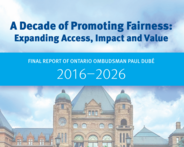 Departing Ontario Ombudsman Paul Dubé publishes his final report

On 24 March 2026, Ontario Ombudsman Paul Dubé published a special report summarizing his 10 years in office, a period of historic growth in public sector oversight.
The departing Ombudsman, whose term ends March 31, highlights improvements in public services, but also calls attention to persistent issues, like the urgent ongoing “crisis” in the province’s overcrowded jails.
Mr. Dubé led the Ombudsman’s Office through the largest expansion of its mandate since it was established 50 years ago. His appointment in April 2016 coincided with legislative changes that added municipalities, universities and school boards to the Ombudsman’s purview, which previously only covered provincial government bodies. In 2019, it was further expanded to include French language services and children’s services (children’s aid societies, foster homes, group homes, youth justice centres and provincial and demonstration schools).
His report details the progress achieved and lessons learned in those expansions – as well as dozens of investigations and hundreds of thousands of individual cases – and emphasizes the resulting value for Ontarians:
“My hope is that Ontarians come to see their Ombudsman as more than useful or helpful, but as truly indispensable,” he writes. “No other institution in Ontario has the mandate, the independence or the capacity to promote fairness and respect for rights in public services in the way we do. At a time when confidence in public institutions cannot be taken for granted, that role has never been more important.”
Taking complaints about such a broad array of public services – and explaining the Ombudsman’s role in improving them – posed significant challenges, says Mr. Dubé, noting: “Many people don’t fully understand the Ombudsman’s role in a healthy democracy.”
To address this, he focused on promoting the Ombudsman’s unique ability to protect the rights of Ontarians to fair, accountable public services. This, he notes, is the common thread between people with developmental disabilities who lack appropriate services, vulnerable inmates in correctional facilities, Francophones unable to access services in their language, children and youth in care struggling to be heard, and residents seeking transparency from their municipal governments or school boards.
Please click here to read the full article.
Source: Ontario Ombudsman, Canada


