
 Back
Back-
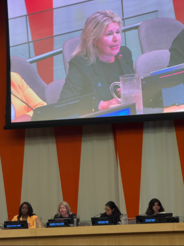 IOI President Nadine Mailloux speaking at the high-level panel

On 18 May 2026, the President of the UN General Assembly (PGA), Ms Annalena Baerbock, convened a high-level panel at the UN Headquarters in New York on “The importance of complying with the Venice Principles for Ombudsman institutions to strengthen the institutions’ independence and autonomy and create an enabling environment to perform their mandate nationally and internationally” in accordance with General Assembly resolution 79/177.
The event started with opening remarks by the PGA followed by Ms Ilze Brands Kehris, Assistant Secretary-General for Human Rights, who underlined the important role of Ombudsman institutions in the implementation of SDG 16 and presented some initiatives of the Office of the UN High Commissioner for Human Rights (OHCHR) to support Ombudsman institutions to carry out their mandates in accordance with international standards.
The subsequent panel discussion, moderated by Ms Ann Syauta, Chief of the Intergovernmental Affairs, Communications and Outreach Section in OHCHR New York, featured Ms. Nadine Mailloux, IOI President and Ombudsman of Montreal in Canada, Ms. Angie Cruickshank Lambert, 1st Vice-President of the Ibero-American Federation of Ombudsman (FIO) and Ombudswoman of the Republic of Costa Rica, and Mr. Rafael Bustos Gisbert, Spanish Member of the Venice Commission of the Council of Europe and Professor of Constitutional Law at the Complutense University of Madrid. The aim was to discuss and share best practices on how the Venice Principles can strengthen Ombudsman and mediator institutions and to highlight some of the main challenges as well as discuss how the Venice Principles can help to prevent or mitigate such challenges.
In her intervention, IOI President Nadine Mailloux argued that the Venice Principles are not an aspirational text but an operational threshold, one that defines the institutional architecture without which an Ombudsman cannot meaningfully protect individuals against arbitrary administrative power. Drawing on the IOI’s vantage point across more than 200 institutions in over 100 countries, she identified three recurring patterns that erode Ombudsman independence worldwide: silent budgetary asphyxiation, the discreet politicization of appointments where leaders are selected for their deference rather than their willingness to dissent and the narrative erosion through which institutions are publicly discredited to discourage institutional courage.
Speaking with characteristic frankness, Ms Mailloux contended that the obstacles to compliance are rarely technical, they are almost always political. To address them, she proposed four concrete commitments that any State could implement within a single legislative cycle: constitutional entrenchment, parliamentary control over the budget, robust protection against removal, and the explicit recognition of ex officio investigative powers.
She also turned the panel’s attention to two emerging frontiers: algorithmic governance, which produces a new category of systemic harm escaping traditional individual remedies, and global crises : climatic, migratory, security-related, that multiply zones of administrative urgency where procedural safeguards are too often the first to be sacrificed.
Finally, Ms Mailloux expressed the IOI’s readiness to assume a more structured role in supporting institutional compliance with the Venice Principles, through an IOI-led accreditation mechanism designed with and for its member institutions. She framed this not as a claim but as a natural responsibility, one that belongs, by the logic of things, to the body best placed to hold it.
You can find the IOI President’s full speech in the download section below.
The recording of the event is available here.
Source: The IOI General Secretariat


