
 Back
Back-
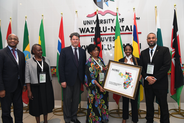 Ceremonial handover at the AORC relaunch

African Ombudsman Research Centre Relaunch and Training Programme 2026 successfully convened in Durban, South Africa
The African Ombudsman Research Centre Relaunch and Training Programme, held from 23 to 25 March 2026 at the University of KwaZulu-Natal, brought together over 75 delegations from across Africa and beyond to discuss and explore strategies informed by research on how Ombudsman institutions in Africa can strengthen mechanisms for oversight of public service delivery, identifying systemic challenges in public administration, and promoting ethical conduct and transparency in the exercise of public power.
The event, convened under the theme “Using Ombudsman Powers to Strengthen Governance and Advance SDGs in Africa,” marked a strategic reset for AORC as a continental hub for research, training, and institutional capacity building.
In her opening address, Kholeka Gcaleka, Chairperson of the AORC Board, emphasised that:
“AORC is not just a platform for learning — it is a vehicle for African-led knowledge, accountability, and governance transformation.”
The programme highlighted the evolving role of Ombudsman institutions from complaint-handling bodies to drivers of systemic reform, contributing directly to transparency, accountability, and improved service delivery by government institutions.
High-level participants included Antónia Florbela de Jesus Rocha Araújo, President of the African Ombudsman and Mediators Association (AOMA), alongside Heads of various Ombudsman across Africa and the Deputy Minister of Justice and Constitutional Development in South African Mr. Andries Nel graced the occasion and remarked that “Today, ombuds institutions are not only reactive complaint-handling entities, but proactive agents of change advancing human rights, strengthening access to justice, combating corruption, and reinforcing the rule of law. This expanded role aligns closely with continental and global priorities, including Agenda 2063 and the United Nations Sustainable Development Goals, particularly the imperative to build strong, accountable institutions.”
This renewed era of continental collaboration and institutional strengthening was supported by the Department of International Relations and Cooperation, South Africa through the African Renaissance Fund, in partnership with the Public Protector South Africa and University of KwaZulu-Natal.
The relaunch was a vehicle to, position AORC to deliver a structured multi-year programme focused on governance and institutional capacity building. A key milestone in AORC’s evolution is its role in advancing formal academic training in Ombudsmanship. Work already underway at the University of KwaZulu-Natal, in collaboration with Ombudsman institutions, signals a pioneering step toward establishing Africa as a leader in professionalising the field.
Ombudsman institutions, serve as the “rearview mirror” of society, providing governments with data-driven insights and recommendations grounded in investigation and research, which is essential in addressing challenges such as poverty and inequality especially in Africa.
AORC’s focus is on capacitating institutions across Africa and to amplify Africa’s voice on the global stage. Heads of Ombudsman institutions should lead with integrity and accountability to drive meaningful change to advance democratic values across the continent.
The relaunch of AORC represents more than a renewal, it signals a strengthened, collective commitment to building capable institutions, advancing knowledge, and delivering measurable impact for the people of Africa
As highlighted during the programme:
“This relaunch is therefore not just a celebration. It is a reset.”
The AORC Relaunch is expected to enhance the capacity of African Ombudsman institutions to address systemic governance challenges and contribute meaningfully to the implementation of Agenda 2063 and the Sustainable Development Goals.
Source: African Ombudsman Research Centre


