
 Back
Back-
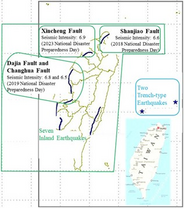 Distribution of Scenario Simulation Themes for Seven Large-Scale Earthquakes, 2018–2026 (Source: National Science and Technology Center for Disaster Reduction, NCDR)

At the end of 2025, the Government of Japan released a damage assessment report on a Tokyo inland earthquake. To examine the effectiveness of Taiwan’s disaster assessment mechanisms for a similar earthquake, members of the 6th-term Control Yuan (CY) questioned officials from the relevant agencies and consulted experts and scholars in April 2026, subsequently completing an investigation report. The CY has sent its investigation opinions to the National Science and Technology Council (NSTC), the Ministry of the Interior (MOI), and the Office of Disaster Management, Executive Yuan (ODMEY), requesting that they conduct a review and make improvements, focusing on the following three points:
1. The NSTC’s earthquake scenario simulations for Taiwan’s active faults suffer from insufficient capacity, slow progress, and limited funding; the CY urges the ODMEY to strengthen oversight and ensure improvements:
At its 39th meeting on November 28, 2018, the Central Disaster Prevention and Response Council (CDPRC) resolved to task the NSTC with developing scenario simulations and damage estimates for earthquakes caused by the rupture of “major faults” in Taiwan. The investigation found, however, that the seven large-scale earthquake scenario simulations conducted by the NSTC since 2018 have covered only four faults: the Shanjiao, Xincheng, Dajia, and Changhua faults (see figure).
The investigation further found that, although multiple active faults run through Taiwan’s densely populated metropolitan areas, the NSTC’s funding for scenario simulations is limited: it conducts only one earthquake disaster scenario simulation each year, in conjunction with the MOI on National Disaster Prevention Day—a rate that is far too low and reflects clearly insufficient capacity. Moreover, compared with the 30 scenario sets (including extreme scenarios) used in Japan’s simulation of a Tokyo inland earthquake, the NSTC’s simulations raise concerns that the data have been presented in an overly favorable light, which could mislead the relevant agencies in their disaster preparedness and leave the public inadequately protected.
2. The MOI has difficulty concretely assessing the disaster mitigation effectiveness of simulation results, reducing the application of earthquake scenario simulations to a mere formality:
The investigation report noted that Japan set 10-year disaster mitigation targets for a Tokyo inland earthquake in 2013 and, in 2025, reviewed its progress toward the targeted reductions in areas such as “estimated deaths,” “building damage,” and “number of evacuees.” The Japanese government has also put forward a range of disaster mitigation measures, such as improving the seismic resistance of housing and other buildings, and mandating or encouraging the seismic retrofitting of buildings along both sides of “specified emergency transport roads” to prevent collapsed structures from obstructing rescue vehicles. These measures offer valuable lessons for Taiwan. The ODMEY should strengthen its oversight of the MOI to implement and refine the targets set by the CDPRC.
3. Taiwan’s earthquake disaster prevention system is fragmented; experts recommend following Japan’s example by establishing a dedicated disaster prevention agency to systematically accumulate and integrate disaster prevention and response information:
Experts and scholars consulted by the CY noted that earthquakes have historically caused the heaviest casualties of any single type of disaster event in Taiwan, and that earthquake disaster prevention warrants the attention it deserves. Whereas Japan publicly released its Tokyo inland earthquake simulation results in late 2025 and urged its citizens to take concrete preparedness measures, Taiwan’s earthquake disaster prevention system remains fragmented. Moreover, the annual National Disaster Preparedness Day drills focus primarily on disaster response, while the funding and resources devoted to disaster simulation are insufficient, and deliberations on assessing and improving the seismic performance of infrastructure such as buildings, transportation, and lifeline utilities still lack concrete data and long-term tracking. The experts unanimously recommended that the Executive Yuan follow Japan’s example by establishing a dedicated disaster prevention agency to systematically integrate disaster prevention and response information and address a wide range of disaster risks.
Source: Control Yuan, Taiwan


